G.I. Joe A Real American Hero #21 - Silent Interlude
Release Date: December 1983
Cover Date: March 1984 (1st Printing)
Versions: Direct Market, Newsstand, Canadian Priced,
2nd Printing (Bagged in Marvel Comics $1.69 3-Comic Pack
with #22 )
& 3rd Printing (July 1985)

Not included here are the many reprinted versions, other silent issues and languages, plus the story of the G.I. Joe ARAH #21 2nd Printing
Credits:
Story & Breakdowns: Larry Hama · Finishes: Steve Leialoha ·
Coloring: George Roussos · Editor: Denny O'Neil · Editor-in-Chief: Jim Shooter ·
Cover Artist: Ed Hannigan · Cover Inker/Colorist: Klaus Janson ·
+ (Letterer: Rick Parker, uncredited title page, credits only)
How it was Made:
G.I. Joe ARAH #21 was made on a short deadline. Writer Larry Hama was approaching a production crunch for the next issue when he made a decision that would change comics history: he would tell the entire story without a single word of dialogue. Working over a weekend, Hama sketched all 22 pages himself — placement of heads, arms, feet and weapons on each panel, the full choreography mapped out before a finisher touched it. No letterer required. Steve Leialoha finished inking the pages at speed. George Roussos colored it. Editor Denny O'Neil approved it. The book made it to the printer on time.
Key Story Details:
The story opens on Castle Destro. Scarlett has been captured and is being delivered by the ninja in white. A G.I. Joe commando, Snake Eyes, drops from a C-130 in HALO kit, fights through Cobra soldiers and reaches the castle dungeon cell — only to find Scarlett has already broken free on her own. Snake Eyes then fights past three Red Ninja assassins and the ninja in white to escape. They reunite and escape together on the same vehicle she arrived on. In the final panels on the last page, the ninja in white — who never gives his name — sees the tattoo on the commando's exposed forearm. These two men know each other. That shared mark opens a mystery that would define G.I. Joe storytelling for the next 40 years.
Legacy and Importance:
Silent Interlude appears on "greatest comics of all time" lists alongside single issues from Batman, Watchmen, and The Dark Knight Returns. Its cover has been homages and parodied more than almost any comic of the 1980s. In 2022, the original cover art sold at auction for over $300,000. Many working comic professionals today can attribute their move to be a comic artist from reading G.I. Joe ARAH #21 as a kid. The issue introduced Storm Shadow, the Red Ninja, and the Arashikage tattoo as well as starting the Scarlett & Snake Eyes and the Destro and Baroness relationships — characters and concepts that have appeared in every G.I. Joe medium since: toys, cartoons, movies, video games, and 40 years of comics. It achieved all of this without a single spoken word.
From Author Josh Eggebeen:
This was tons of fun to make and it will grow with time. G.I. Joe ARAH #21 The Silent Issue is not actually wordless. Read on to see the words and enjoy the story.
Videos: Larry Hama talking creating #21 & G.I. Joe at event in 2019 These videos are from an event in Sept 2019 that was filmed at the Museum of the Chinese in America in downtown Manhattan, NYC, Sponsored by Nerd News Today. Copy the link. https://www.youtube.com/watch?v=_WdVSEkSjCs https://www.youtube.com/watch?v=Uf4KmEu-jPg https://www.youtube.com/watch?v=9dJXl4cR0Os https://www.youtube.com/watch?v=tDnPDWTf6xk https://www.youtube.com/watch?v=umRMidWzsQc
STATS: Character
Appearances:
* Snake Eyes — 14
pgs, panels = 53
(5 in disguise)
* Scarlett — 12 pgs,
panels = 43
(7 covered at start)
* Storm Shadow — 9 pgs,
panels = 40
* Destro — 4 pgs, panels = 11
(2 hand-only)
* Cobra Commander — 2 pgs, panels = 5
* Red Ninjas — pgs for
sword 3, sai 2,
kusarigama 3,
panels = 17
* Cobra Soldiers — 7 pgs, panels = 29
* Baroness as chess piece — 1 pg, panels = 3
* Snake Eyes + Scarlett
in same panel = 8
* Cobra Commander +
Storm Shadow in
same panel = 4
* Destro + Baroness
chess piece in same
panel = 3
* First appearances = 4
Storm Shadow,
3 Red Ninja

Jump to Individual Pages:
Front Cover · Page 1 · Page 2 · Page 3 · Page 4 · Page 5 · Page 6 · Page 7 ·
Page 8 · Page 9 · Page 10 · Page 11 ·
Page 12 · Page 13 · Page 14 · Page 15 · Page 16 · Page 17 · Page 18 · Page 19 · Page 20 · Page 21 · Page 22 ·
Marvel Bullpen Bulletins Special ·
Postbox: the Pit! · Ads ·
STATS:
Comic & Pages:
-
Total story pgs = 22
-
Total physical pgs = 34
-
Non-Story pgs = 12
-
Total panels = 116
-
Vertical panels = 66
-
Horizontal panels = 48
-
Square panels (p.10) = 6
-
Splash pgs = 1
-
Average panels per pg = 5.3
-
Word or thought balloons or Editor's Notes = 0
-
Total written story words = 35
-
Total words on 22 pgs = 59
-
Ads pgs = 10
-
Video Game ads = 3
-
Ads double pg spread = 1 (Atarisoft)
-
Marvel Comics pgs = 3 Bullpen, Postbox & Subscription

The #21 Page by Page Breakdown Begins NOW!!!
A few notes to read before starting: Josh Eggebeen of After Action Report has spent his life collecting and writing about G.I. Joe Comics. This kind Deep Dive into G.I. Joe is the next evolution of AAR with online content matching the quality of the actual AAR books created over the last 6 years. For the scans of the pages, the interior pages are from the most current PDFs included in the Skybound Compendiums. The covers, ads & 1st page are scans from Josh Eggebeen's #21 bought at his local comic shop in Tulsa, OK in 1984.
The M's ()Maestro's ) Summary is AI-assisted content, reviewed and approved by AAR. Josh's Comments are Josh Eggebeen. Expect additional content, stats and commentary from other authors to be added to this Deep Dive. YoJoe!!

The advertisements of #21 are included as part of the history of the entire comic, which are an important part in determining differences between printings.
Plus, they are just COOL!!

Cover Stats:
Panel Count: 1 (splash)
Credits: Artist: Ed Hannigan and Inker/Colorist: Klaus Janson
Location: Exterior wall · Destro's Castle
Characters: Snake Eyes
Weapons: Uzi, rope, grenade, knife & pistol in leg holster
M's Summary: The cover that launched a thousand collections. Snake Eyes hangs from a rope on the exterior wall of Destro's Castle, looking up, goggles on, expression unreadable behind the mask. Ed Hannigan and Klaus Janson deliver one of the most iconic covers in Marvel Comics history — dynamic, clean, and instantly arresting. The caption says it all: "The Most Unusual
G.I. Joe Story Ever!!!" It is not wrong.
Josh's comments: G.I. Joe is a team and Snake Eyes is a key member of the team as established in the previous 20 issues. The #21 cover has become iconic, rising above all others for G.I. Joe, with Snake Eyes in dramatic action style fashion firing his Uzi as he rappels down. He matches his toy design which means according to his File Card he is a Commando. Snake Eyes is in commando mode on the cover BUT by the last page, the reader knows Snake Eyes and the new villain Storm Shadow as a ninja. But this single character cover stands out in
G.I. Joe lore because it presents the new star of G.I. Joe and the interior story introduces the Arashikage Clan tattoo without a single word. Which is why it's “The Most Unusual G.I. Joe Story Ever!!”
Notable: Both cover artists' initials are below the White Spidey Head Direct Market symbol — a unique detail for Marvel comics of the era.
Notable for the ads: The vintage ad placements on screen mirror their placement in the physical comic — Left stays Left, Right stays Right. Click any vintage ad for the full history of what they were selling in 1984. Click the modern ad to help keep the lights on at AAR.
Advertisement
Left: Vintage Ad#1 in comic Front Inside cover
- Ad name: Master of The universe Monogram model kits
Right: Modern Ad - Google
FRONT COVER
Page 1
Page ##'s: Story /Artwork #1, Physical Book #2
Panel Count:: 1 (splash)
Credits: Story & Breakdowns: Larry Hama · Finishes: Steve Leialoha · Colors: George Roussos · Editor: Denny O'Neil · Editor-in-Chief: Jim Shooter *
Location: Exterior (Ext) / airspace above castle
Characters: Storm Shadow, Scarlett
Weapons: None
Transport: Cobra CLAW
M's Summary: The story opens without a single word of introduction. A full-page splash: Castle Destro, carved into a Trans-Carpathian cliff face, cold and impenetrable. A white-clad figure moves through the night, carrying a bound captive on a Cobra CLAW. No caption tells you where you are. No dialogue tells you who they are. Larry Hama trusts the image completely. In one page, before a word has been spoken or a name given, the tone of everything that follows is set. This is not a rescue story that starts with the rescue. It starts with the capture, already done, already clinical, the castle already swallowing its prisoner whole.
Josh's Comments: Destro's Castle aka the Silent Castle arrives front and center on Page 1 and it would be a location that is returned to many times, it even transforms which calls out to a well known bad guy robot in disguise. BUT the true genius of the page is the key first appearance of a character that will forever always be connected to Snake Eyes. With a big opening splash page a lot is introduced. And for a first time reader of the issue no words on the page seems right.
Notable: Title page and credits box appear here on the first page. The "Stan Lee presents:" as a prologue to the title is a standard at the time on all Marvel Comics comment. Stan Lee had nearly zero to do with the G.I. Joe comic at any point.
* The credits were made by G.I. Joe regular letterer Rick Parker, uncredited.
Notable: In most reprint versions the indicia is removed, as that is specific copyright information to Marvel Comics and can be replaced by the current publisher copyright info. The "Stan Lee Presents" prologue title is often removed, but not always.

Above & Below:
Definition: The indicia is the small-print block inside a comic book (usually the bottom of the first interior page) that contains the official legal and publishing information:
-
Title and issue number
-
Volume number
-
Cover date
-
Publisher name and address
-
Copyright statement
-
Printing number (1st, 2nd, etc.)
-
ISSN or other identifiers
For collectors it is the single most reliable way to identify a specific printing. The cover can vary, the ads can change, but the indicia is the legal record of exactly what that copy is.
Notable: For ARAH #21 specifically the indicia is how you confirm 1st vs 2nd vs 3rd Printing — and how the mystery of the 2nd Printing was started.

The Indicia
What follows is not in the story. It's in the fine print.
This is a full breakdown of the Indicia from directly above.
The Missing Trademark — Scarlett a. Who made the list: Five characters are named in the Hasbro trademark block: G.I. Joe, Snake-Eyes, Storm Shadow, Cobra Commander, and Destro. These are the five names Hasbro had trademarked and was actively protecting in early 1984. Look at that list. It is the five biggest toy sellers. It is not the five most important characters in ARAH #21. b. Who didn't: Scarlett. The second most present character in ARAH #21 — appearing on 12 of the 22 story pages, behind only Snake Eyes at 14 — is completely absent from the trademark block. She carries the issue. She is captured, defiant, and the entire reason Snake Eyes goes into that castle. Her name is not in the legal record of the issue she drives. c. Three reasons this likely happened: First, "Scarlett" is a code name. Hasbro may have been slower to formally trademark code names versus the brand itself. Second, only the five biggest commercial toy sellers got named — Scarlett's figure sold fewer units than Snake-Eyes or Cobra Commander in 1984. Third, and most telling: the trademark block reflects toy sales priority, not story importance. The legal record of this comic is a snapshot of what Hasbro's sales team valued in early 1984. Not what Larry Hama's story valued. Consider who made the list and who didn't. Storm Shadow was a brand new character, introduced in the 1984 toy line the same year as ARAH #21. He debuted and went straight onto the protected list. Scarlett was one of the original 13 G.I. Joe figures from 1982 — two years on shelves, drives the entire issue, still not in the trademark block. New character: protected. Founding member: not. M's Note: Scarlett is the reason this issue exists. She is not in the legal record of the issue. That is pure 1984 — and one of the most telling details in the entire indicia.
60 Cents — The 1983 Price Point Price 60¢ per copy in the U.S. and 75¢ in Canada." 60 cents. That is what a kid handed over at a newsstand in December 1983 to read ARAH #21 for the first time. b. Why the price line matters to collectors: For ARAH #21 specifically, where three printings exist across Newsstand and Direct Market versions, the indicia is one of the most reliable identification tools. The price line, the printing notation, the copyright year — all of it is in 6-point type at the bottom of page 1. Most collectors never look there. c. The 3rd Printing confirmation: The 3rd Printing indicia is identical to the 1st Printing indicia with one addition: the words "3rd Printing" in extra type. Same price, same publisher, same address. The indicia is how you confirm which printing you are holding when the cover alone doesn't tell you. M's Note: 60 cents in December 1983. The price is still in the fine print. So is everything else.
Who Owned Marvel in 1984? a. The line: "A division of Cadence Industries Corporation." That is who owned Marvel Comics in early 1984. Not Disney. Not Ron Perelman. Cadence Industries Corporation — a mid-sized New York conglomerate. Jim Shooter, Marvel's Editor-in-Chief at the time, cited actual Cadence Industries subscription data in the History of #21 book. The corporate structure named in this indicia was real enough to produce internal documents that Shooter held onto for decades. b. What this means: This is pre-Perelman Marvel — before the 1986 leveraged buyout that took Marvel private, loaded it with debt, and eventually led to the 1990s bankruptcy that nearly destroyed the company. The Cadence era was Marvel's most commercially successful period. The company was dominant, the books were selling, and G.I. Joe ARAH was one of its top titles. The indicia names the corporation that owned all of it at that exact moment. c. From Cadence to the MCU: The bankruptcy that followed the Perelman era forced Marvel to sell off its movie character rights to survive. Spider-Man went to Sony. X-Men and Fantastic Four went to Fox. Those sales kept Marvel alive in the late 1990s. When Marvel Studios eventually launched and built the MCU, they did it without Spider-Man, without the X-Men, without the Fantastic Four — because those rights had been sold off during the darkest chapter of Marvel's corporate history. What Marvel did have was Iron Man. Iron Man (2008) was the first MCU film precisely because it was one of the characters Marvel still owned. The road from Cadence Industries to Iron Man runs directly through the fine print of this indicia. d. A snapshot frozen in fine print: ARAH #21 is a Cadence Marvel, published at the peak of Marvel's commercial dominance before the corporate chaos that followed. M's Note: Most collectors never look at who owned Marvel when they read their old comics. The indicia tells you exactly where the company was in its own history the moment that issue was printed.
Canada, Foreign & International a. The line: "Canada and Foreign, $9.20." Nine dollars and twenty cents for 12 issues. That is the subscription price Marvel charged Canadian and foreign readers in 1984. One line. One number. Proof that G.I. Joe ARAH was an international comic from issue #1. b. What it confirms: Hasbro and Marvel were not thinking small. G.I. Joe was shipping internationally from the beginning of the ARAH run. The $9.20 foreign subscription rate versus $7.20 domestic covered international postage costs. G.I. Joe was not a US-only property that expanded overseas later. It launched globally. c. The international collector rabbit hole: Canadian price variants, UK editions, Australian editions, and foreign language printings of ARAH are their own collecting universe. The Canadian price variant of ARAH #21 is a documented separate catalog entry. UK Action Force editions adapted the stories for a British audience. Australian editions carried different pricing. Foreign language editions exist across multiple countries. One line in the indicia opens the door to an entire chapter of G.I. Joe collecting history that most American collectors have never explored. M's Note: This is the line most collectors walk right past. Nine dollars and twenty cents. G.I. Joe was already everywhere. The data has been sitting in the fine print since 1984.
The Marvel Masthead — Four Names a. The four names: James E. Galton — President Stan Lee — Publisher Michael Hobson — Vice-President, Publishing Milton Schiffman — Vice-President, Production Four executives. Four names in 6-point type at the bottom of page 1. This is the leadership team running Marvel Comics the month ARAH #21 hit newsstands. b. James Galton's legacy: James Galton ran Marvel from 1975 to 1986 — eleven years as President under Cadence Industries, presiding over the most commercially dominant era in the company's history. Under his presidency Marvel dominated the newsstand, built the direct market relationship, and published the comics that defined a generation of readers. None of them knew what Hama had just handed them. Galton was running the most successful comics company in the world and one of his editors had just published a silent issue that would still be discussed 40 years later. c. Stan Lee as Publisher: Stan Lee is listed as Publisher, not Editor or Writer. By 1984 his creative days on individual titles were long behind him. He had relocated to Los Angeles and his focus was Hollywood — getting Marvel characters onto screens. TV was working: Spider-Man and His Amazing Friends was running on Saturday mornings, the Incredible Hulk TV series had completed a successful run, and Marvel's animated properties were reaching millions of kids. Movies were a different story — Marvel's film attempts in this era produced little of note. Lee was the public face of Marvel's entertainment expansion while Galton ran the business and editors like O'Neil ran the comics. Stan Lee had no direct creative involvement with G.I. Joe ARAH. His name is in the fine print of it anyway. d. Michael Hobson — VP Publishing: Michael Hobson oversaw the business side of Marvel's print operations as Vice-President of Publishing. In practical terms that meant the newsstand distribution relationships, the subscription fulfillment operation, and the retailer network that was rapidly becoming Marvel's primary sales channel as the Direct Market grew. The subscription math and the postal rate application sitting elsewhere in this indicia were his operational world. e. Milton Schiffman — VP Production: Milton Schiffman was responsible for the physical manufacturing of every Marvel comic as Vice-President of Production. Color separations, printing specs, paper stock, press schedules, printer relationships. In 1984 that meant an almost entirely manual process — color separations done by hand, paste-up boards, film negatives, and printing plates, with computers playing virtually no role in the production of a comic page. Every page of ARAH #21 that came off a press did so under his operational oversight. His name is two lines below Stan Lee's in the indicia. Almost nobody knows it. M's Note: Four names. One moment. None of them in the room when Hama drew a single panel of it.
No Subscriber Service Discount a. The numbers: Cover price: 60¢ per issue. Subscription rate: $7.20 for 12 issues. $7.20 divided by 12 = exactly 60¢ per issue. Zero discount. Not a penny off for subscribing in 1984. b. Zero financial incentive: For a periodical that is unusual. Subscriptions typically reward readers with a lower per-issue cost to encourage long-term commitment. Magazines, newspapers, any periodical built on recurring readership — the subscription price is almost always lower than newsstand. Marvel was not making that offer in 1984. Subscribers got convenience, not savings. c. Why this might have been: The Direct Market was growing fast in 1984. Comic shops were becoming Marvel's primary retail backbone. Marvel may have been deliberately not undercutting shop prices with cheap subscription rates — protecting the retailer relationship that was becoming more valuable than the newsstand. The subscription math in the indicia is a small window into a much larger business decision that would define comics distribution for the next 30 years. M's Note: Best trivia question in the whole indicia. "What was the subscriber discount for Marvel comics in 1984?" The answer is zero. Right there in 6-point type. Nobody ever reads it.
Authorized Dealers & Cover Strips a. The line: "This periodical may not be sold except by authorized dealers and is sold subject to the conditions that it shall not be sold or distributed with any part of its cover or markings removed, nor in a mutilated condition." One sentence. Two separate legal declarations. Both of them tell you exactly how the comic business worked in 1984. b. The Direct Market in legal language: The first half is the authorized dealer system written into the comic itself. In 1984 Marvel was actively controlling who could sell their comics. Unauthorized resellers were explicitly prohibited. The authorized dealer network that sentence describes is the direct ancestor of today's comic shop exclusive system. c. Cover-stripped copies — the newsstand returns system: The second half is the newsstand returns policy in legal language. Newsstands that could not sell unsold copies stripped the covers and returned them to the distributor for credit. The coverless copy was supposed to be destroyed. Marvel's own indicia declared it illegal to sell a copy with its cover removed. Coverless G.I. Joe ARAH comics exist in serious collections. They are the physical evidence of a newsstand return system that Marvel's own legal text declared illegal. A coverless ARAH comic is not a damaged book. It is a document of how the newsstand distribution system actually worked in 1984. M's Note: The indicia says coverless copies should not exist. They exist anyway. Every one of them is proof the system worked exactly the way Marvel described — and that somebody along the way kept the body instead of destroying it.
Second Class Postage Pending a. The line: "Application to mail at second class postage rates is pending at New York, NY and at additional mailing offices." b. What second class postage means: Second class is the cheaper postal rate for periodicals. Magazines and newspapers qualify. First class is more expensive. Marvel was applying for the cheaper rate for G.I. Joe ARAH but had not yet secured it by issue #21. "Pending" means the application was filed and waiting for approval. c. Why this matters commercially: Cheaper postage equals lower subscription fulfillment costs equals either more profit on each subscription or the ability to offer a lower subscription price. The business of comics in 1984 is inside this sentence. Marvel was fighting for postal classifications the same way every publisher did. The fact that it was still pending at issue #21 means the series launched before the paperwork cleared. M's Note: Nobody reads the postage line. It is the most overlooked sentence in the indicia. It is also a direct window into the operational reality of running a monthly comic in 1984.
Shooter / O'Neil — Not in the Indicia a. The creative credit: The story credits box on the splash page names Denny O'Neil as Editor. He is the person who worked with Larry Hama, approved the silent issue concept, and shepherded ARAH #21 from script to print. b. The legal credit: The indicia names Stan Lee as Publisher and the executive team. No editor is listed anywhere in the indicia. The legal record of this comic does not name the person most responsible for its day-to-day editorial decisions. c. Two credit systems, same page: The splash page credits the creative team. The indicia credits the corporation. They are two different systems operating side by side on the same first page of the same comic. Denny O'Neil is named on the story. He does not appear in the legal document of the story. Neither does Jim Shooter, Editor-in-Chief above O'Neil. Shooter carried more business responsibility than any editor on staff. He managed budgets, interfaced with Cadence Industries leadership, and sat between the creative floor and the corporate owners. If anyone on the editorial side belonged in the legal record of a Marvel comic, it was Shooter. The indicia still does not name him. The legal record names the executives above the editorial chain entirely. The people who actually made the comic are on the actual page. M's Note: The legal record names the executives. The story credits name the people who actually made the comic. On the most important silent issue in comics history, the man who said yes to the silence is nowhere in the fine print. Neither is the man above him.
387 Park Ave in NYC— Marvel's Address a. The address: "OFFICE OF PUBLICATION: 387 PARK AVENUE SOUTH, NEW YORK, N.Y. 10016." 10th Floor That address appears twice in the indicia of ARAH #21 — once as the office of publication, once as the subscription mailing address. 387 Park Avenue South sits on the northeast corner of Park Avenue South and East 27th Street in Manhattan's NoMad/Flatiron District. The building was constructed in 1910, designed by the architectural firm Clinton and Russell. It was a 12-to-13-story pre-war commercial office building already over 70 years old when ARAH #21 was printed there. b. One stop on a long journey: 387 Park Avenue South was not Marvel's first address and not its last. Marvel began as Timely Comics in 1939 in the McGraw-Hill Building, moved to the Empire State Building, then to Madison Avenue (635, then 575), then to 387 Park Avenue South, then onward to 10 East 40th Street, 417 Fifth Avenue, and eventually 135 West 50th Street. Eight addresses across Marvel's history. 387 Park Avenue South is the one in the indicia of ARAH #21. Jim Shooter noted on his blog that Marvel moved from 575 Madison Avenue to 387 Park Avenue South around June 1981. G.I. Joe ARAH launched in 1982. Every issue from #1 forward was made at 387 Park Avenue South. One notable detail: when Marvel was at 635 Madison Avenue, the indicia listed 625 Madison Ave — the parent publishing company's address, not Marvel's actual office. The indicia address was not always where the work happened. At 387 Park Avenue South, the indicia and the actual office aligned. c. The Bullpen at 387: The Marvel Bullpen — the open production floor where comics were lettered, colored, pasted up and shipped — operated out of this address during the entire ARAH run. Rick Parker, the letterer on hundreds of Marvel comics in this era, wrote about life at 387 Park Avenue South in detail. His firsthand account appears in AAR Vol. 1, Pages 9 and 10. d. What it means that it's in the indicia: Marvel's physical address appears in the legal record of every comic published from this office. ARAH #21 carries it twice. The address is not a historical footnote — it is the mailing address every subscriber used to receive their copy. Thousands of G.I. Joe readers sent letters and subscription payments to 387 Park Avenue South, Manhattan, in 1984. e. What the building is today: 387 Park Avenue South still stands. Over $20 million in renovations between 2012 and 2017 transformed it: glass lobby overhaul, a glass skybox penthouse on the roof, landscaped roof deck, modernized elevators. The ground floor is a CVS pharmacy. The upper floors house creative office tenants including a tech company headquarters. The building where Marvel's Bullpen lettered, colored, and shipped comics through the most dominant era in the company's history is now a CVS and a tech office. The high ceilings and large windows that made it ideal for industrial work in 1910 now serve open-plan creative offices. The indicia still says 387 Park Avenue South. The building just forgot it was ever Marvel. M's Note: The address in the fine print is where the comic was made. It is where Denny O'Neil said yes to a silent issue. It is where Larry Hama's pages arrived by messenger. 387 Park Avenue South, New York, N.Y. 10016. Built in 1910. Still standing. The indicia put it there permanently. The ground floor is a CVS now.
"What Is a Comic Book Indicia?" a. Definition: The indicia is the small-print legal publishing block found at the bottom of the first interior page of a comic book. It is not part of the story. It is not read by most collectors. It is the fine print nobody looks at. For ARAH #21 it is one of the most information-dense single paragraphs in G.I. Joe collecting history. b. What the indicia tells you about THIS comic: G.I. Joe A Real American Hero. Vol. 1, No. 21. Published March 1984. Price 60¢. Published by Marvel Comics Group. Office of Publication: 387 Park Avenue South, New York, N.Y. 10016. One line of fine print gives you the title, the volume, the issue number, the month, the price, and the publisher. Everything a librarian, a lawyer, or a collector needs to identify this exact printing of this exact comic. c. The legal fingerprint: The indicia is the legal fingerprint of a printing. Two printings of the same issue can have different indicia — different dates, different corporate structures, different price points. For ARAH #21 specifically, comparing the indicia across printings is one of the most reliable ways to tell them apart. The information has always been there. Most collectors never read it — because at 6-point type on a printed page, most collectors can't see it. M's Note: Every collector has held this page. Almost nobody has read the bottom of it. That changes right here.
Two Copyright Holders — One Comic a. The split: G.I. Joe® is copyright ©1984 by Hasbro Industries, Inc. Everything else in the comic — the story, the art, the writing — is copyright ©1983 by Marvel Comics Group. Two separate companies. Two separate copyright years. One comic book. G.I. Joe was created by Hasbro in 1964. Hasbro has never sold the property to anyone. They license it. The Marvel ARAH comic was a creative partnership built to sell toys — Hasbro owned the brand and the characters, Marvel provided the creative engine. The indicia confirms it: Hasbro's copyright covers G.I. Joe. Marvel's copyright covers everything outside Joe — the creative work, the storytelling, and critically any Marvel Universe crossover content. When Scarlett lands on a man in a Halloween costume who turns out to be the Hulk, that moment lives under Marvel's copyright, not Hasbro's. Two companies. One page. Both in the fine print. b. What this means for reprints: Larry Hama created the world, the characters, and the stories. He owns none of it. The ROM situation taught Hasbro exactly what happens when a toy company lets a publisher own the creative work — Marvel ended up owning the entire ROM lore, the Dire Wraiths, the Spaceknights, everything Bill Mantlo and Sal Buscema built, while Hasbro kept only the toy name and the armored look. Hasbro almost certainly structured the G.I. Joe deal to avoid repeating that. The indicia reflects it: Hasbro's copyright covers G.I. Joe. Marvel's copyright covers all other material. Larry Hama receives creator credit and royalties. The actual rights belong to the two companies in that indicia — not to the man who wrote every word. c. The copyright year difference: Notice that Hasbro's copyright is ©1984 and Marvel's is ©1983. The story was written and drawn in 1983. The comic was published and on newsstands in early 1984. Two different moments in the same creative process, each with its own legal clock. M's Note: This is the single most commercially consequential sentence in the indicia. Every dollar ever made from reprinting this issue traces back to these two lines.
The Hunt for the ARAH #21 2nd Printing — It Started Here a. The mystery: For nearly 20 years the G.I. Joe collecting community knew three printings of ARAH #21 existed. The 1st Printing Direct Market and Newsstand with the white Spider-Man head on the cover. The 3rd Printing with the black Spider-Man head on the cover. The 2nd Printing was the ghost. Everyone knew it should exist and nobody could prove it — because you can't have a 1st and a 3rd without a 2nd. b. Where the hunt began: Comics are dated documents. Every advertisement inside a comic, every back cover, every indicia entry ties that specific printing to a specific window of time. Collectors who knew how to read those details — cross-referencing ad placements against other Marvel titles from the same month — had a forensic toolkit most readers never thought to use. The 2nd Printing hunt used exactly that toolkit. c. Josh's Comment: In the early 2000s as G.I. Joe comic readers including myself were returning to collecting, the conversation on comic forums (which pre-dated social media by at least a decade) began talking about why there was no ARAH #21 2nd Printing. The 3rd Printing with the Black Spidey Head on the cover was widely known, so it was a true mystery. One of the very first key clues were the advertisements inside and on the back cover of the comic. The Frogger cover and Captain America Reach for the Stars back covers helped identify which month those comics were released in connection with other Marvel Comics titles of the same month. And so the mystery hunt for the ARAH #21 2nd Printing, which took nearly 20 years to solve, began with the indicia information and back cover.
G.I. JOE® A REAL AMERICAN HERO™ Vol. 1, No. 21, March, 1984. Published by MARVEL COMICS GROUP, James E. Galton, President. Stan Lee, Publisher. Michael Hobson, Vice-President, Publishing. Milton Schiffman, Vice-President, Production. OFFICE OF PUBLICATION: 387 PARK AVENUE SOUTH, NEW YORK, N.Y. 10016. Application to mail at second class postage rates is pending at New York, NY and at additional mailing offices. Published monthly. G.I. JOE, SNAKE-EYES, STORM SHADOW, COBRA COMMANDER, and DESTRO are trademarks of HASBRO INDUSTRIES, INC. and the likenesses of the characters to which those names are applied are the property of HASBRO INDUSTRIES, INC., and the trademarks and likenesses are used with permission of HASBRO INDUSTRIES, INC. G.I. JOE® Copyright ©1984 by HASBRO INDUSTRIES, INC. All rights reserved. All other material copyright ©1983 by Marvel Comics Group, a division of Cadence Industries Corporation. All rights reserved. Price 60¢ per copy in the U.S. and 75¢ in Canada. Subscription rate $7.20 for 12 issues. Canada and Foreign, $9.20. Printed in the U.S.A. No similarity between any of the names, characters, persons, and/or institutions in this magazine with those of any living or dead person or institution is intended, and any such similarity which may exist is purely coincidental. This periodical may not be sold except by authorized dealers and is sold subject to the conditions that it shall not be sold or distributed with any part of its cover or markings removed, nor in a mutilated condition. Postmaster: Send address changes to Subscription Dept., Marvel Comics Group, 387 Park Avenue South, New York, N.Y. 10016.
Page 2
Page ##'s: Story #2, Physical #3
Panel Count: 5
Location: Ext Airspace above castle, Interior (Int) Cobra Throne Room
Characters: Storm Shadow, Scarlett
Weapons: Sword
Transport: Cobra CLAW
M's Summary: Storm Shadow pilots a Cobra CLAW through the night sky into the castle, his captive hanging bound beneath him. It is the first time readers see Storm Shadow in motion — and he moves like someone completely at ease with what he is doing. No urgency, no drama. Just the cold efficiency of a mission already completed. He draws his sword as he arrives — a single gesture that tells the reader everything: this is a ninja.
Josh's Comments: Let the Introductions and mysteries begin. Wait! Where are the words? Who is in white flying the Cobra CLAW? Who has he captured? BUT what is really being introduced is a masked man in a white shinobi shozoku (that is the official name of the traditional outfit of a ninja) wielding a sword is a NINJA to G.I. Joe ARAH. This moment is the beginning of a massively important change for the entire G.I. Joe ARAH brand. So important -- 40 years later the ninja still plays a huge role with the toys and comics.
Notable: The red Cobra shoulder emblem is absent from his uniform.


Page ##'s: Story #3, Physical #4
Panel Count: 6
Location: INT Castle Throne Room / cell corridor, Ext airspace above castle
Characters: Storm Shadow, Scarlett, Cobra Commander, Cobra Soldiers
Weapons: Sword
Transport: C-130
M's Summary:
Scarlett is revealed — and she is not broken. Storm Shadow presents his captive to Cobra Commander, who recognizes her immediately. This is not their first encounter: she drove a throwing star into his arm back in ARAH #1, and he has not forgotten. Storm Shadow bows before Cobra Commander — not in submission, but to deliver his prize. The deeper meaning of that gesture won't be understood until ARAH #26 and #27. Scarlett is walked to her cell. The page closes with a silhouette that stops readers cold: a C-130 against a full moon.
Josh's Comments:
Ok. Where are the words? And now we see Scarlett has been captured by the Ninja in white. The talkative Cobra Commander does NOT say anything. He just points. What is happening? No one is talking? BUT there is a tremendous amount of story telling happening in these 5 panels. The reader on this page starts to grasp the concept of what would become known as the Silent Issue, and why it's an Unusual Story. Oh, and is that a plane over the Castle?
Notable: In ARAH #22 Grunt talks to Snake Eyes about how Scarlett is captured. She was on a certification test for a parachute drop when Storm Shadow snatches her in mid drop.
Notable: In Top Left Panel Cobra Commander is drawn outside the borders of the panel, this happens a couple more times in ARAH #21. Page 7 Snake Eyes' foot and most notably Page 22 Storm Shadow's foot.
Page 3
Page 4
Page ##'s: Story #4, Physical #5
Panel Count: 5
Location: Ext High altitude airspace above / Destro's Castle visible below
Characters: Snake Eyes
Weapons: Full HALO kit, Uzi
Transport: C-130
M's Summary: Five vertical panels, no words, pure freefall. Snake Eyes drops from the C-130 in full HALO kit — high altitude, no parachute deployed, the castle somewhere below him in the dark. Hama uses the vertical panel structure perfectly here, each frame a beat of the fall, the silence of the page matching the silence of the jump. There is no hesitation, no internal monologue, no mission briefing. Just a commando doing what commandos do. The odds are not in his favor. Snake Eyes jumped anyway.
Josh's Comments: It's Snake Eyes, so we know he doesn't speak, so him jumping out of the plane means no word or thought balloons.. And for the record in G.I. Joe comics thought balloons rarely appear, and if they do it's not from a Hama written issue. So Snake Eyes falls toward Destro's Castle BUT what is he going to do? That is just one more mystery being set up.
Notable: The pilot of the C-130 is Wild Bill, although not shown, he is confirmed in Hasbro Figure Pack Comic 21B and DDP Snake Eyes Declassified TPB (Disavowed)(2006)
Notable: Snake Eyes standing in the C-130 with red lighting in Panel 2 was adapted as the cover art for the AAR History of G.I. Joe ARAH #21 book with cover art by Brian Sauer.


Advertisement
Left: Vintage Ad#2 in comic right side
- Ad Name: Magic Glo Racers
Right: Modern Ad - Made Up name for search
Page 5
Page ##'s: Story #5, Physical #7
Panel Count: 9
Location: Int Scarlett's cell
Characters: Scarlett, Storm Shadow
Weapons: Sword & Teeth
Transport: None
M's Summary: Scarlett is alone in her cell and she is already working the problem. Storm Shadow comes to check on his captive — a mistake. She bites his thumb and stands her ground. He is not rattled. She is not broken. The exchange between them is wordless and electric — two professionals sizing each other up, one imprisoned and one holding all the cards, and yet somehow the prisoner has the upper hand in every panel. She is defiant, calculating, refusing to be passive for a single moment. The cheek bandage she wears is a timestamp of her struggle, a wound from the capture already behind her.
Josh's Comments: The readers already know Scarlett is a martial artist from her File Card and previous issues and she had already foiled Cobra plans many times, so seeing her captured is an unexpected surprise. BUT What is this Ninja in white all about? No one knows, even Hama as he created it didn't know. And now the reader truly understands this is a wordless comic — all the storytelling is happening through artwork images. All the storytelling is happening through panels story telling images.
Notable: In the ARAH continuity, how she got the cheek bandage remains unaddressed. In the DDP Snake Eyes Declassified TPB (Disavowed)(2006), Storm Shadow strikes her in the head — directly where the cheek bandage appears later off panel to put the band aid on the wound— offering an explanation outside ARAH continuity.
Notable: The original 1984 printing shows the ceiling hatch open in Scarlett's cell. Per Hama's request it was first corrected to closed in the IDW G.I. Joe Silent Interlude 30th Anniversary Edition. The correction matters because the cell hatch is not a background detail. It appears on 8 pages across the issue, Page 5 through Page 17, becomes a weapon twice, and Snake Eyes stands over it on Page 16. Leaving it open on Page 5 spoils the entire prop.


Advertisement

Comparison of Change (Below):
Left: Hatch Closed in IDW 30th Anniversary Edition 2014
Right: Hatch Open Original #21 March 1984 version
Left: Vintage Ad#3 in comic right side
- Ad Name: Bubble Yum
Right: Modern Ad - a very famous search engine
Page ##'s: Story #6, Physical #9
Panel Count: 5
Location: Int Destro's command room
Characters: : Destro
Weapons: None
Transport: None
M's Summary: Destro appears sitting at his computer console — calm, analytical, already three steps ahead. A chess set sits beside him, its pieces arranged like a battlefield. The metaphor is not subtle and it doesn't need to be: Destro sees this entire situation as a game, and he is confident he knows how it ends. The computer screen delivers the majority of the text in the issue — appearing twice: "Security Status: Intruder" and "Factors: Altitude of Intruder Aircraft: High Wind Velocity Darkness; Lack of Landing Zones ... Probability Successful air-born insertion: .000018."* Destro reads it and is unmoved. What he does not account for is that the man falling toward his castle has never much cared for odds.
Josh's Comments: Destro, also a well known character of action, is sitting in his Command Center at a computer screen. In 1984, computers were just arriving in people's homes, and calculating odds this way was a new idea to many. BUT now we have words on the page and they are not word or thought balloons, and so far missing in the comic are a caption or editor's note both common ways to communicate to the reader. A talking computer helping Destro determine if an intruder is coming, again unique story telling.
Notable: ARAH #21 is called a silent issue. But it is not wordless. The computer screen on this page contains nearly the only written text in the story.
* The word air-born is hyphenated and minus the "e" on the screen.
Page 6

Page 7
Page ##'s: Story #7, Physical #10
Panel Count: 4
Location: Ext airspace above the castle, exactly on the head of the Castle's Cobra statue tower
Characters: Snake Eyes
Weapons: Uzi, rappelling gear
Transport: Parachute
M's Summary: Snake Eyes deploys his parachute and lands on the highest point of Destro's Castle — a giant Cobra statue perched on the ramparts. It is an extraordinary landing, and Hama frames it as such: one man, alone, on top of an enemy stronghold, having just fallen from the sky against odds that should have killed him. The castle design itself — inspired by the G.I. Joe animated series castle created by Larry Houston — gives Snake Eyes the perfect entry point. He has arrived. Now the real work begins.
Josh's Comments: Snake Eyes, the Silent Intruder, arrives by parachute beating the .000018 odds landing on top of Destro's Castle. What is he going to do? The G.I. Joe team members know he is a badass, the readers so far have only seen glimpses of the badass mentioned on his File Card. BUT now it's time to introduce the never before seen true badass ninja Snake Eyes we all now know well.
Notable: Snake Eyes descending down the Cobra statue can actually be bought as a real life statue for your bookcase.

Page ##'s: Story #8, Physical #11 -- Per page stats:
Panel Count: 7
Location: Exterior wall / Scarlett's cell
Characters: Snake Eyes, Scarlett, Cobra Soldier
Weapons: Hairpin, rappel gear, Uzi, Cobra Soldier's gun
Transport: None
M's Summary: Inside her cell, Scarlett works a hidden hairpin against her chains — patient, methodical, already planning her own exit. Snake Eyes rappels down the exterior wall and drops from above onto a Cobra Trooper on guard. No warning, no sound. The guard never saw it coming. These are two people who do not need to coordinate to move in the same direction.
Josh's Comments: Scarlett and Snake Eyes each show off their skills individually in different parts of Destro's Castle. For the reader, the Snake Eyes/Scarlett relationship is a known part of the G.I. Joe BUT up to this point it has been subtle. ARAH #21 is the true beginning of their relationship as Snake Eyes comes to rescue her as she begins to rescue herself eventually rescuing him.
Notable: The bottom left panel — Snake Eyes on the rope on the castle shield wall of the tower — is the inspiration for the iconic cover image.

Page 8
Page 9
Page ##'s: Story #9, Physical #12 -- Per page stats:
Panel Count: 5
Location: Int Destro's command room / cell corridor
Characters: Destro, Storm Shadow
Weapons (of the Chess pieces): Uzi, sword, crossbow,
.50 cal gun (Kwinn)
Transport: None
M's Summary: Destro stands before his chess set, studying the board. The top panel shows the pieces in play: on one side Scarlett, Snake Eyes, Hawk and Rock 'n Roll — on the other Cobra Commander, Storm Shadow and a Cobra soldier. Four pieces lie fallen off the board — Dr. Venom, Kwinn, Scarface, and the Baroness. Destro holds the Baroness piece in his hand. It is a quiet, telling moment: Destro processes war as strategy, not carnage. In the bottom panel, Storm Shadow's boots move toward a heavy two-handled hatch in the floor — Scarlett is still in her cell, the escape not yet begun.
Josh's Comments: Bring on the back story, again with no words, showing dead characters as chess pieces on Destro's board as a story element for the past and the future.. Wait, is the Baroness really dead? Does he know she survived the HISS Tank explosion? The reader does! BUT what is that look he has on his masked face? Love? Grief? Again, like Scarlett/Snake Eyes, the Baroness/Destro relationship had only been hinted at in the previous 20 issues. And that is another genius storytelling moment in a comic that has yet to even reach its biggest mysteries. And the final panel shows us the all important cell hatch cover.
Notable: ARAH #22 features Destro's chess set on its cover, with a different character arrangement.

Page Count: Story #10, Physical #14
Panel Count: 6
Location: INT Cell hatch cover / corridor
Characters: Scarlett, Storm Shadow
Weapons: Chain, hatch cover, sword
Transport: None
M's Summary: Scarlett ambushes Storm Shadow as he opens the hatch. She throws her heavy chain at his head, flips him down into the cell below — but Storm Shadow grabs her leg on the way down. She drives the heavy hatch cover onto him, breaking his grip and making her escape. It is one of the most satisfying sequences in the issue — the captive turning the tables completely, using her restraints as a weapon. Storm Shadow never saw it coming.
Josh's Comments: The ninja in white has a Cobra symbol on his suit now proving he is a Cobra. That is a big hint. He is opening the cell hatch cover BUT he has dramatically underestimated Scarlett and pays for it with a chain to the head and neck plus the cell hatch cover slammed on his head. The cell hatch cover is a weapon.
Notable: The Cobra symbol appears on Storm Shadow's uniform for the first time.
Notable: Scarlett's chain goes down into the cell with Storm Shadow — yet she has it again on Page 15 when attacking the Cobra soldiers. This continuity gap is addressed in the Hasbro Comic Pack 21B.
Notable: The heavy hatch cover Scarlett uses here reappears on Page 16 — Snake Eyes picks it up and uses it to block a Red Ninja sword strike. It is also a corrected error between editions (See Page 5 above)

Page 10

Left: Vintage Ad#4 in comic Left page
- AD Name: Zorcom Space Ship
Right: Modern Ad - from original name of BackRub
Advertisement
Page 11
Page ##'s: Story #11, Physical #15
Panel Count: 5
Location: Ext Castle parapet (rooftop)
Characters: Snake Eyes, Cobra Soldiers
Weapons: Uzi, multiple knives, Cobra Soldier's gun, rope
Transport: None
M's Summary: Snake Eyes fights his way through Cobra soldiers inside the castle — and he does it almost entirely with knives. No Uzi, no grenades, no heavy weapons. Just blades, speed, and silence. It is a subtle but important shift: this is the page where Snake Eyes stops being purely a commando and starts revealing something else entirely. The transition from soldier to ninja happens here without a single word to announce it. The Cobra soldiers never had a chance.
Josh's Comments: How badass is Snake Eyes? The beginning of his true skills really shows up here as he fights silently against Cobra Soldiers with his knives. A commando he is, but the blur motion drawn in the final two panels shows how fast he is. BUT can he stay the Silent Intruder?
Notable: The top panel is setting up Snake Eyes in disguise later notice on the top of parapet is the Uzi on the left and rope on the right. It is also how he loses his Uzi.

Page ##'s: Story #12, Physical #16
Panel Count: 6
Location: Ext Castle parapet, exterior window, Int Destro's Command Center, Int rampart stairs
Characters: Snake Eyes, Cobra Soldier, Destro
Weapons: Bare hands, Uzi, Destro's pistol, Cobra Soldier's gun
Transport: None
M's Summary: A Cobra Soldier gets his hands around Snake Eyes' throat — and Snake Eyes throws him off the castle wall. The falling Cobra Soldier causes Snake Eyes to lose his Uzi over the edge. No hesitation, no alternative considered. Destro watches the soldier fall from a window, takes stock of what is happening in his own castle, and makes a decision: he leaves his console and personally enters the fight. It is a revealing character moment. Destro is not a man who delegates when the situation demands his direct attention. The chess player has left the board.
Josh's Comments: Not for very long is Snake Eyes undetected. Destro, seeing a Cobra Soldier fall past his window, is now aware that his odds were beaten on the parachute drop. So he rallies the troops. BUT a small detail on this page is sometimes missed by readers. Snake Eyes’ Uzi falls with the Cobra Soldier. On Page 11 the top panel shows it on the left, with the rope on the right. Now he has used up his knives, lost his Uzi as more of the commando is going away, he starts to fight like a ninja, BUT he shows he is still a good guy by hanging the Cobra Soldier — whose uniform he stole for his disguise — alive, upside down in his underwear on the wall by the rappelling rope. Good guys only kill when they have to.
Notable: The Cobra Soldier chocking him is the same one from Page 11 top panel (with night vision goggles but missing helmet), which is same one as Page 8 (with night vision goggles and helmet)


Above: Double page Spread AD #5 (left) & #6 (right) - Ad Name: Atarisoft
below: Modern big banner Ad - by potential name googolplex
Page 12
Advertisement
Advertisement
Advertisement
Page 13
Page ##'s: Story #13, Physical #19
Panel Count: 5
Location: Ext Castle parapet
Characters: Snake Eyes, Destro, Cobra Soldiers
Weapons: Stolen Cobra Soldier uniform including night vision goggles & helmet, Destro's pistol, Cobra Soldier guns and rope
Transport: None
M's Summary: Snake Eyes steals a Cobra soldier's uniform and infiltrates the rooftop — leaving the soldier hanging upside down in the process. Destro spots a falling helmet and knows something is wrong. Snake Eyes pulls off the disguise and drops the night vision goggles, shifting back into full commando mode. It is a brief moment of dark humor in an otherwise relentless issue — one man, alone in an enemy stronghold, stopping to change clothes while the entire castle hunts him.
Josh's Comments: BUT he shows he is still a good guy by not killing the Cobra Soldier, whose uniform he steals for his disguise andand leaving him alive hanging upside down in his underwear off the wall by the rappelling rope. Good guys only kill when they have to. Destro is fooled by the disguise.
Notable: The stripped Cobra Soldier hanging upside down in his underwear is one of the few moments of visual wit in the issue.

Page 14
Page ##'s: Story #14, Physical #20
Panel Count: 5
Location: Int Castle hallway
Characters: Storm Shadow, 3 Red Ninja (not named) (here they are named by their weapons: sword, sai, kusarigama)
Weapons: Swords, sai, kusarigama
Transport: None
M's Summary: The first-ever appearance of the Arashikage Ninja Clan. Three shadows appear on the rooftop before the ninjas themselves — Hama introduces them in silhouette first, letting the shapes do the work. They carry a sword, sai, and kusarigama. Storm Shadow stands apart from them, composed, his sword undrawn. He does not need to draw it. This page plants a seed that won't fully bloom until ARAH #26 and #27 — but even here, without a single word of explanation, something larger than a rescue mission announces itself.
Josh's Comments: The hatch cover is left open and empty. And here comes the next big introduction. Ninja in red. Storm Shadow summoning them with a finger knitting symbol has 3 Red Ninja, each with a distinct different weapon, drop from the ceiling. These Red Ninja are the first real introduction of the Arashikage Ninja Clan. Of course, not named. BUT the reader would later see these Red Ninja fighting against and with Snake Eyes and Storm Shadow many times.
Notable: This is the first appearance of the red-clad Arashikage Ninja Clan and Storm Shadow's connection to it in ARAH continuity. During the 1980s ninja trend ninja were nearly always wearing black. Hama gives the G.I. Joe ninja characters white and red colors. Leaving the ninja in black to be Snake Eyes.
Definition: Sai: A traditional Okinawan weapon with a metal baton and two curved prongs. Used for blocking sword strikes, trapping blades, and close-quarters combat. Typically carried in pairs. The Red Ninja (sai) uses them here both offensively and as a last defense against Snake Eyes' grenade on Page 17.
Definition: Kusarigama: A Japanese weapon combining a small sickle (kama) on one end with a weighted chain (kusari) on the other. The chain can be swung to entangle an opponent's weapon or limbs before delivering a strike with the blade. One of the most complex and difficult weapons in the ninja arsenal. The Red Ninja (kusarigama) wields it through Pages 18 and 19.

Page 15
Page ##'s: Story #15, Physical #21
Panel Count: 5
Location: Int hallway
Characters: Scarlett, Cobra Soldiers
Weapons: Chain
Transport: Cobra CLAW
M's Summary: Scarlett is out of her cell and moving. She finds two Cobra soldiers carrying the CLAW and takes them both from behind — wrapping her escape chain around their necks and cracking their heads together. Clean, efficient, devastating. The CLAW is hers. What makes this sequence remarkable is that Scarlett does not wait for Snake Eyes to find her, does not wait to be led to safety. She locates her own ride out and takes it. The rescue mission has become a joint escape operation.
Josh's Comments: Hama over the decades has consistently created female characters that can kick ass. Scarlett shows off her skills as she escapes using items like her hairpin and the heavy chain to evade being recaptured. After easily dispatching two Cobra Soldiers, she captures the same Cobra CLAW she was brought in on. BUT will she escape Destro's Castle?
Notable: The Cobra CLAW is rarely, if ever, used in the comics, yet, its a prominent part of the story for ARAH #21. Now in the cartoon the Cobra CLAW is used all the time, The first G.I. Joe animated cartoon (not the commercials for the comic) first aired Sept 12th, 1983 - The M.A.S.S. Device, so just 4 months before #21 hit spinner racks.


Advertisement
Left: Vintage Ad#7 in comic right side
- Ad Name: Gotta-Get-A-Grit! & Comics Convention (Manhattan, Los Angeles, Washington DC)
Right: Modern Ad - by original spelling GooGol
Page 16
Page ##'s: Story #16, Physical #23
Panel Count: 7
Location: Int Scarlett's former cell corridor
Characters: Snake Eyes, Red Ninja (sword)
Weapons: Sword, hatch cover
Transport: None
M's Summary: Snake Eyes faces a Red Ninja (sword) sword strike and blocks it with the heavy hatch cover Scarlett left behind. The same piece of iron that bought Scarlett her escape now saves Snake Eyes' life. It is one of the tightest pieces of visual storytelling in the issue — two characters, two separate fights, one prop connecting them across six pages without a single word to call attention to it.
Josh's Comments: Standing over the empty cell, with the hatch cover open and loose, Snake Eyes is attacked from above and behind by a Red Ninja with a sword. Hama again uses the blur motion to show the speed of the attack and defense. The Red Ninja is easily dispatched by using the cell hatch cover similar to how Scarlett did. Does Snake Eyes know these ninja in red, of course he does. They are from the same Ninja Clan he belongs to BUT the reader does not know that.
Notable: The hatch cover is first used as a weapon on Page 10 when Scarlett drives it down on Storm Shadow. Its reuse here is the kind of detail that rewards a second read.
Notable: This is the first time Snake Eyes encounters a Red Ninja. An Arashikage Ninja. He would 100% know who they are. He is a member of the same Clan.


Advertisement
Left: Vintage Ad#8 in comic right side
Ad Name: Individual Comic Shops - Make Big Money
Modern Ad - by Barney Google, a 1919 comic strip
Page 17
Page ##'s: Story #17, Physical #25
Panel Count: 6
Location: Int hallways
Characters: Snake Eyes, Red Ninja (sai)
Weapons: U.S. M1A Grenade, sai
Transport:
M's Summary: Snake Eyes spots a Red Ninja (sai) approaching in his visor reflection. He reaches for a US M1A Grenade, thumb on the pin — and holds. The Red Ninja raises his sai. Two fighters, perfectly still, each daring the other to move first. It is the most tension-packed sequence in the issue, and it is completely silent. The grenade's text is the second and final instance of written words in ARAH #21: "US M1A Grenade, Fragme..." — the last letters cut off.
Josh's Comments: Snake Eyes, basically weaponless, moves up the stairs to meet another Red Ninja (Sai) with sais. In a standoff, Snake Eyes dispatches the Red Ninja with a single grenade. He used his last commando weapon. BUT is that really Snake Eyes' final weapon.
Notable: "U.S. M1A Grenade, Fragme..." is one of only two instances of written text in the entire issue — the other being Destro's computer screen on Page 6.

Page 18

Page ##'s: Story #18, Physical #26
Panel Count: 5
Location: Int hallways
Characters: Snake Eyes, Storm Shadow, Red Ninja (kusarigama)
Weapons: Sword, kusarigama, bare hands
Transport: None
M's Summary: The grenade explodes. The second Red Ninja (sai) is gone. Snake Eyes walks out of the smoke and straight into a three-way bare-handed fight — Storm Shadow with his sword, a third Red Ninja (kusarigama) with a kusarigama. No pause, no recovery moment. The page keeps moving at the same relentless pace the issue has maintained since Page 4. This is the deepest point of the issue — the most danger Snake Eyes has been in, the furthest from the exit, with Scarlett already airborne on the CLAW above him. And the first time he fights Storm Shadow.
Josh's Comments: The weaponless Snake Eyes walks up the stairs into a double ninja ambush. And Page 18 becomes the very first time Storm Shadow and Snake Eyes meet on a comic page. They would go on to have a long shared history fighting together and against each other BUT in this hallway Snake Eyes is fighting two ninja with only his hands and feet, one ninja he would for sure know right away as he is his sword brother with a long history together. Again, the reader would NOT know this connection, yet. And even Hama at the time of drawing this scene did NOT KNOW of the connecting story he would weave over the next 40 years.
Notable: The grenade explosion on this page matches the explosion art on all figure cards of the 1980s created by Hector Garrido.
Notable: On this page is the very first meeting of Snake Eyes and Storm Shadow in print. Two characters that would define G.I. Joe storytelling for the next 40 years, with a in story shared history that long predates this meeting.
Page 19
Page ##'s: Story #19, Physical #27
Panel Count: 5
Location: Int hallways, Ext airspace above parapet
Characters: Snake Eyes, Storm Shadow, Scarlett, Red Ninja (kusarigama)
Weapons: Kusarigama, sword, hands & feet
Transport: Cobra CLAW
M's Summary: Snake Eyes throws the Red Ninja (kusarigama) into Storm Shadow's sword slice, turning one enemy against the other. Then he drives his feet down on Storm Shadow's head, dazing him. A weapon cuts Snake Eyes' right forearm sleeve — a small detail that will matter enormously in two pages. Above, Scarlett has reached the CLAW and is airborne. She looks back in shock seeing the running Snake Eyes as a dazed Storm Shadow recovers below. The escape is happening. But it isn't over yet.
Josh's Comments: Snake Eyes is a ninja in black. The commando has used up his weapons and is now fighting with just his body against a ninja in red with a kusigama and ninja in white with a sword. Bad ass Snake Eyes defeats both leaving Storm Shadow dazed from a double foot stomp to the head. In a hard to spot moment in the very middle panel Snake Eyes right arm is exposed as his uniform is cut. He is still hunting for Scarlett to rescue her. And as he exits who shows up on the CLAW, it's not a hard guess. BUT does Snake Eyes know the ninja in white is his sword brother, of course he does in the story. Again, neither Hama nor the reader would know how they are connected until ARAH #26 & #27.
Notable: The cut to Snake Eyes' right forearm (center middle panel) sleeve is the setup for the tattoo reveal on Page 22 — Hama plants it here without drawing any attention to it.

Page 20
Page ##'s: Story #20, Physical #28
Panel Count: 6
Location: Ext Castle parapets / airspace above
Characters: Storm Shadow, Scarlett, Snake Eyes
Weapons: Sword
Transport: Cobra CLAW
M's Summary: Storm Shadow stands alone, recovering. His right arm band is loose. Scarlett is on the CLAW, looking back — first with relief seeing Snake Eyes alive, then with a reaction that stops the reader cold. Something she sees changes her expression completely. Hama holds the reveal for one more page, letting Scarlett's shock do the work. The reader doesn't know what she saw. They just know it matters.
Josh's Comments: Scarlett flying the captured CLAW spots Snake Eyes, the smile on her face shows her joy at seeing him. Storm Shadow with sword in hand and his arm band becoming loose, that loose arm band hides the Arashikage tattoo symbol, will try to kill them. And that is what bad guys do: they kill, establishing the ninja in white as truly a bad guy (at least in this issue). BUT when a reader sees these panels without the context of this reveal the focus is on Storm Shadow preparing to throw his sword, not the arm band.
Notable: Storm Shadow's loosened right arm band is a visual setup for the reader and inside the story what is under the arm band is seen by both Scarlett and Snake Eyes. The Arashikage tattoo beneath it is about to be revealed.

Page 21
Page ##'s: Story #21, Physical #30
Panel Count: 6
Location: Ext Castle parapets / airspace above
Characters: Storm Shadow, Snake Eyes, Scarlett
Weapons: Sword & hands (sword caught bare-handed)
Transport: Cobra CLAW
M's Summary: Storm Shadow throws his sword at Scarlett on the CLAW. Snake Eyes catches it bare-handed — out of the air, without flinching. Scarlett closes her eyes, bracing for the worst. Then opens them. She is alive. The man she loves just caught a thrown sword out of the air with his bare hand to save her life. Storm Shadow's eyes go wide. Not at the catch. At what the catch reveals: Snake Eyes' torn right forearm sleeve falls away, exposing the Arashikage tattoo. Storm Shadow recognizes it instantly. These two men know each other. The sword throw, the catch, the closed eyes, the tattoo — four beats in one page that reframe everything that just happened across 21 pages. Nothing about this rescue mission was coincidence.
Josh's Comments: As the sword flies straight at Scarlett. The ninja in black does what only a trained ninja with exceptional skill can do. He catches the sword in mid air with both hands saving Scarlett. Storm Shadow seeing the skill and seeing the exposed arm of Snake Eyes knows who he has been fighting. AND now we get to what Hama has described as a problem he needed to solve. Both characters had their arms exposed during the battle and he did not know what to do with it. So he used an idea he had drawn in an Iron Fist story 10 years prior. He put the I Ching tattoo on them, one he could easily remember.
Notable: Snake Eyes catching Storm Shadow's thrown sword bare-handed is one of the most iconic single moments in G.I. Joe comic history.
left: Vintage Ad#9 in comic left side
- Ad Name: Marvel Bullpen Bulletins Special with the might marvel checklist
Right: Modern Ad from the garage


Advertisement
Page 22
Page ##'s: Story #22, Physical #31
Panel Count: 3
Location: Ext Castle parapets / airspace above
Characters: Scarlett, Snake Eyes, Storm Shadow
Weapons: None
Transport: Cobra CLAW
M's Summary: The last page. Scarlett and Snake Eyes escape on the CLAW into the night sky. Scarlett smiles — the smile of someone who just survived something that should not have been survivable. She turns to Snake Eyes, her face shifting from relief to something warmer, more private. Hama draws it with just enough ambiguity to let the reader fill in the rest — and what most readers fill in, after 22 pages of wordless tension, is a kiss. It may have happened. The page does not deny it. Storm Shadow stands alone on the ramparts below, fists clenched, his right arm band fully loosened. He pulls it back. The Arashikage tattoo is visible on his forearm — matching the one just revealed on Snake Eyes. Two ninja clan brothers. One on each side of a war neither of them chose. Larry Hama closes a 22-page silent story with an image that opens a mystery large enough to fuel the next 100 issues.
Josh's Comments: The escape!!! Scarlett rescues Snake Eyes with a smile, Snake Eyes hugging Scarlett from behind on the CLAW and on the ground at top of Destro's Castle stands Storm Shadow looking up and mad for letting them escape. AND they both have the same tattoo on their arms, which the reader would have recognized as an extremely important, almost supernatural union between them. AND in the story both characters would have recognized the other making this is an extremely important moment. A tattoo of an ancient real world Chinese divination text called the I Ching turns a team comic into a starring Snake Eyes & Storm Shadow after 21 pages of AWESOME! Hama used it to fuel the Snake Eyes and Storm Shadow story for next 40 years of ARAH."
In the context of the story of the Silent Issue, so much is revealed in its 22 pages. But the one thing left out is the name of the ninja in white, so the reader would have to wait for that to be revealed in a future comic or get the toy AND File Card. BUT the savvy reader who read the very next page in Postbox: The Pit got what today would be called a Spoiler in answers from the editor.
And that wraps up a landmark issue in the history of comics. It changed the course of the G.I. Joe brand, it introduced ninja, it set in motion three relationships that would stand the test of time and keep an entire generation of kid fans of G.I. Joe well into their middle aged adulthood, gave Larry Hama a very long career and many of those kids would be inspired to become comic artists themselves, AND even a few got to draw Snake Eyes, Scarlett, Storm Shadow, Cobra Commander, Destro and the Baroness as professionals in the comic industry. The influence of ARAH #21 is still being felt in the 2027 comic market with homages and more silent stories being told.
AND Hama did it all cause the comic needed to be made fast.
Notable: The Arashikage tattoo reveal on the final page is the single most consequential story beat in G.I. Joe comic history — everything that follows for Snake Eyes and Storm Shadow begins here. AND it is precisely why ARAH #21 stands as one of the most important single issues in all of comic book history.
Notable: When Hama created ARAH #21 in late 1983, he had no idea what he had created. It took him until ARAH #26 and #27 to fully realize it. Those stories are where the real mythology begins. Stay tuned for the page by page breakdown of those issues.

Left: Vintage Ad#10 in comic right side
- Ad Name: Postbox: The Pit (G.I. Joe Letters Column)
Storm Shadow's name is revealed 4th paragraph down in the left column as an Editor's answer to a reader's question

Left: Vintage Ad#11 in comic left side
- Ad Name: Marvel Comics Subscription service Holiday Special with Inhumans Black Bolt, Medusa & Lockjaw
(G.I. Joe would soon be the highest selling subscription for MArvel)

Left: Vintage Ad#12 Inside BAck Cover right side
- Ad NAme: Master Of The Universe Video Game
Below: Modern AD by company Name Alphabet

Advertisement
Back Cover

Above: Vintage Ad#13 Back Cover
- Ad NAme: frogger Video Game
Below: Modern AD by Google Again!
Advertisement
M's Summary: The Back Cover of ARAH #21 is not just an advertisement — it is one of the most important collector identification tools in the entire Marvel ARAH run. The Frogger Parker Brothers ad appearing here is the definitive marker of a 1st printing. The 2nd printing also features the Frogger Back Cover — but the comic is sealed inside a Marvel Comics 3-pack with ARAH #21, #22, and #23 in a $1.69 bag, released late 1984 or 1985. Sealed is the only way it is a 2nd printing. The 3rd printing, July 1985 Direct Market, replaces the Frogger Back Cover entirely with "Reach for the Stars" — a Captain America ad featuring Cap pointing upward with children gazing at the stars — and is marked on the inside with a "3rd Printing" notation alongside the common black Spidey head. An unsealed copy with Frogger on the back is a 1st printing. The full story — every identifying marker, the hunt, and the resolution — is covered in depth in AAR The History of G.I. Joe ARAH #21, pages #56 to #67 titled The Hunt for the G.I. Joe ARAH #21 2nd Printing.
Josh's Comments: In the early 2000s as G.I. Joe comic readers including myself were returning to collecting, the conversation on comic forums (which pre-dated social media by at least a decade) began talking about why is there no #21 2nd Printing, the 3rd Printing with Black Spidey Head on the cover was widely known, so it was a true mystery. And one of the very first key clues were the advertisements inside and on the back cover of the comic. The Frogger cover and Captain America Reach for the Stars back covers helped identify which month those comics were released in connection with other Marvel Comics titles of the same month. And so the mystery hunt for the ARAH #21 2nd Printing began, which took nearly 20 years to solve, with this back cover.
Notable: In May of 1991, Hasbro would buy Parker Brothers and own Frogger. See the Ad gallery below for a detailed history on Frogger and all of the other ads including this Page by Page breakdown.
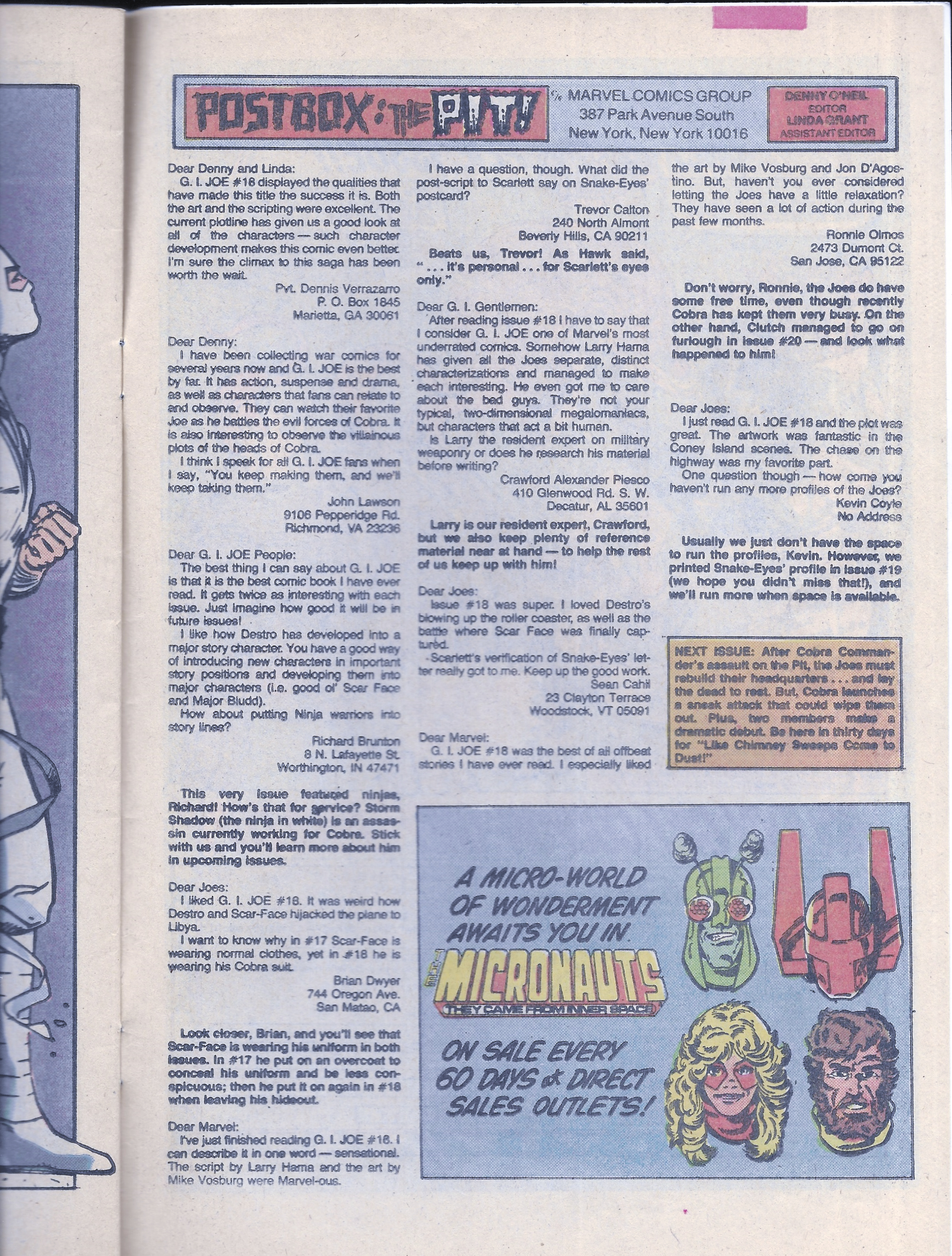
POSTBOX: The Pit
Page ##'s: Physical #32
Credits: Editor Denny O'Neil, Assist Editors: Bonnie Offner & Jon D'Agostino
Reader's Letters: 9 Pv. Dennis Vernaamo, John Lawson, Richard Brunston, Brian Dwyer, Trevor Calton, Crawford Alexander Plesco, Sean Cahil, Ronnie Olmos, Kevin Coyle
Location: aka the mailing address 387 Park Avenue New York, New York 10016
Characters: aka Reader's name
Weapons: None
M's Summary: The letters page of ARAH #21 responds to reader mail from ARAH #18 — three issues earlier. In 1983 the production pipeline between a reader mailing a letter and seeing it published ran months. The responses reference Destro and Scarface, characters fresh in readers' minds from the issues immediately preceding #21 and seen in #21 as chess pieces. Most significantly, the editorial response teases something new coming — a white-clad figure the readers are about to meet for the very first time on the pages directly in front of this letters column. Storm Shadow's name is mentioned before most readers have even finished the issue in their hands.
Josh's Comments: Where is the spoiler warning? Moments after an epic battle, the reader is wondering a million scenarios that could be happening, but likely if they didn’t have 1984 toy packaging they had no idea who the ninja in white was by name. In the left column, the fourth paragraph down Editor Denny O’Neil answers a reader comment with this quote “This very issue featured ninjas, Richard! How’s that for service? Storm Shadow (the ninja in white) is an assassin currently working for Cobra. Stick with us and you’ll learn more about him in upcoming issues.” The true tease of the spoiler is the word “currently” hint hint, Storm Shadow is on a mission and as soon as he finishes that mission he joins G.I. Joe. But O’Neil and Hama had yet to know what was coming as this letters page was printed.


Above: Vintage Ad#10 G.I. Joe Letters Page in Comic Right Side - Ad NAme: Postbox: The Pit
(Notice on the left above Storm Shadow's foot, so literally just after the last story page his name is revealed in the letters page. See the entry below.
Complete Viewable - Postbox: The Pit - Dec 1983 Dear Denny and Linda: G.I. JOE #18 displayed the qualities that have made this title the success it is. Both the art and the scripting were excellent. The current plotline has given us a good look at all of the characters — such character development makes this comic even better. I'm sure the climax to this saga has been worth the wait. Pvt. Dennis Verrazarro P.O. Box 1845 Marietta, GA 30061 Dear Denny: I have been collecting war comics for several years now and G.I. JOE is the best by far. It has action, suspense and drama, as well as characters that fans can relate to and observe. They can watch their favorite Joe as he battles the evil forces of Cobra. It is also interesting to observe the villainous plots of the heads of Cobra. I think I speak for all G.I. JOE fans when I say, "You keep making them, and we'll keep taking them." John Lawson 9109 Pepperidge Rd. Richmond, VA 23236 Dear G.I. JOE People: The best thing I can say about G.I. JOE is that it is the best comic book I have ever read. It gets twice as interesting with each issue. Just imagine how good it will be in future issues! I like how Destro has developed into a major story character. You have a good way of introducing new characters in important story positions and developing them into major characters (i.e. good ol' Scar Face and Major Bludd). How about putting Ninja warriors into story lines? Richard Brunton 8 N. Lafayette St. Worthington, IN 47471 [Editorial response to Richard Brunton:] This very issue featured ninjas, Richard! How's that for service? Storm Shadow (the ninja in white) is an assassin currently working for Cobra. Stick with us and you'll learn more about him in upcoming issues. Dear Joes: I liked G.I. JOE #18. It was weird how Destro and Scar-Face hijacked the plane to Libya. I want to know why in #17 Scar-Face is wearing normal clothes, yet in #18 he is wearing his Cobra suit. Brian Dwyer 744 Oregon Ave. San Mateo, CA [Editorial response to Brian Dwyer:] Look closer, Brian, and you'll see that Scar-Face is wearing his uniform in both issues. In #17 he put on an overcoat to conceal his uniform and be less conspicuous; then he put it on again in #18 when leaving his hideout. Dear Marvel: I've just finished reading G.I. JOE #16. I can describe it in one word — sensational. The script by Larry Hama and the art by Mike Vosburg were Marvel-ous. I have a question, though. What did the post-script to Scarlett say on Snake-Eyes' postcard? Trevor Calton 240 North Almont Beverly Hills, CA 90211 [Editorial response to Trevor Calton:] Beats us, Trevor! As Hawk said, "...it's personal...for Scarlett's eyes only." Dear G.I. Gentlemen: After reading issue #18 I have to say that I consider G.I. JOE one of Marvel's most underrated comics. Somehow Larry Hama has given all the Joes separate, distinct characterizations and managed to make each interesting. He even got me to care about the bad guys. They're not your typical, two-dimensional megalomaniacs, but characters that act a bit human. Is Larry the resident expert on military weaponry or does he research his material before writing? Crawford Alexander Piesco 410 Glenwood Rd. S.W. Decatur, AL 36601 [Editorial response to Crawford Alexander Piesco:] Larry is our resident expert, Crawford, but we also keep plenty of reference material near at hand — to help the rest of us keep up with him! Dear Joes: Issue #18 was super. I loved Destro's blowing up the roller coaster, as well as the battle where Scar Face was finally captured. Scarlett's verification of Snake-Eyes' letter really got to me. Keep up the good work. Sean Cahil 23 Clayton Terrace Woodstock, VT 05091 Dear Joes: I just read G.I. JOE #18 and the plot was great. The artwork was fantastic in the Coney Island scenes. The chase on the highway was my favorite part. One question though — how come you haven't run any more profiles of the Joes? Kevin Coyle No Address [Editorial response to Kevin Coyle:] Usually we just don't have the space to run the profiles, Kevin. However, we printed Snake-Eyes' profile in issue #19 (we hope you didn't miss that!), and we'll run more when space is available. Dear Joes: Don't worry, Ronnie, the Joes do have some free time, even though recently Cobra has kept them very busy. On the other hand, Clutch managed to go on furlough in issue #20 — and look what happened to him! [NOTE: Letter from Ronnie Olmos, 2473 Dumont Ct., San Jose, CA 95122 precedes this editorial response. Letter text not fully legible in scan.] Ronnie Olmos 2473 Dumont Ct. San Jose, CA 95122 NEXT ISSUE: After Cobra Commander's assault on the Pit, the Joes must rebuild their headquarters... and lay the dead to rest. But, Cobra launches a sneak attack that could wipe them out. Plus, two members make a dramatic debut. Be here in thirty days for "Like Chimney Sweeps Come to Dust!"

Above: Vintage Ad#9 Marvel Comics Cross sell Page in Comic Right Side
- Ad Name: Marvel Bullpen Bulletins & The Mighty Marvel Checklist
Below: The Actual Mighty Marvel Checklist with #21 contained in it,
the left column

Marvel Bullpen Bulletins Special
Page ##'s: Physical #29
Credits: Executive Editor Tom DeFalco (interviewer) & Mark Gruenwald, Mike Carlin & Eliot R. Brown (interviewees)
Parts: Interview & Might Marvel Checklist
M's Summary: December 1983. While Larry Hama was racing to finish ARAH #21 in three weeks, the rest of the Marvel universe was in full swing. The Bullpen Bulletins page is a snapshot of what Marvel was publishing and promoting at the exact moment Silent Interlude was being created. Secret Wars was on the horizon. Spider-Man was everywhere with the arrival of #250. The X-Men were building toward their own landmark runs. ARAH #21 did not arrive in a vacuum — it arrived in the middle of one of the most creative periods in Marvel Comics history, and it still managed to stand apart from everything around it.
Josh's Comments: The Bullpen Bulletins was created by Stan Lee as a promotion piece he could talk directly to the reader sharing all kinds of talking points about upcoming Marvel titles and with The Mighty Marvel Checklist. He would talk about character events and occasionally give personal commentary on the real world events happening. Being a monthly part of every Marvel Comic (pre anything electronic) it was one of the few ways a fan could know what was released that month. In the Hunt For #21 2nd Printing, this Bullpen Bulletins was one of the many early clues used to figure out the mystery. As can be seen ARAH #21 is listed in the Cross Sell (this is the technical term for The Mighty Marvel Checklist). If you're looking at G.I. Joe ARAH #21 3rd Printing the Bulletin is different showing G.I. Joe ARAH #37 listed in the Cross Sell. So a different listing gave the clue to month it was released, which early on was a nice discovery but really only the beginning of the mystery of the #21 2nd Printing.
Notable: The Bullpen Bulletins page is a time capsule of Marvel in late 1983 — worth reading alongside the issue itself to appreciate the moment it landed in.
Full viewable list of The Mighty Marvel Checklist Dec 1983 THE THING #9 — Written by JOHN BYRNE. Breakdowns by RON WILSON. Finishes by JOE SINNOTT. DAREDEVIL #204 — Written by DENNY O'NEIL. Pencils by LUKE McDONNELL. Inks by DANNY BULANADI. NEW MUTANTS #13 — Written by CHRIS CLAREMONT. Breakdowns by SAL BUSCEMA. Finishes by TOM MANDRAKE. DAZZLER #30 — Written by FRANK SPRINGER. Inks by VINCE COLLETTA. CONAN THE KING #21 — Written by ALAN ZELENETZ. Pencils and inks by BO HAMPTON. Breakdowns by DAVE SIMON. Cover by MIKE KALUTA. OFFICIAL HANDBOOK OF THE MARVEL UNIVERSE, Book 11 — Disabled, Part II. With art by WALT SIMONSON. MARVEL SUPER-SPECIFICATIONS HANDBOOK. SPIDER-MAN AND DAREDEVIL SPECIAL EDITION #1 — Reprinting the first and early first Daredevil stories from Peter Parker #'s 77 and 25. G.I. JOE #21 — Written and breakdowns by LARRY HAMA. Finishes by STEVE LEIALOHA. AMAZING SPIDER-MAN #250 — Written by ROGER STERN. Breakdowns by JOHN ROMITA JR. Inks by KLAUS JANSON. CAPTAIN AMERICA #291 — Written by BILL MANTLO. Pencils by HERB TRIMPE. Inks by JACK ABEL. CAPTAIN BRITAIN — Penciled and inked by WALT SIMONSON. INDIANA JONES #16 — Written by DAVE MAZZUCCHELLI. Pencils and inks by VINCE COLLETTA. MOON KNIGHT #36 — Written by ALAN ZELENETZ. Pencils and inks by BO HAMPTON. MICRONAUTS #17 (Limited Series) #3 — Written by BILL MANTLO. Pencils by KELLY JONES. CRYSTAR #6 — Written by JO DUFFY. Pencils by RICARDO VILLAMONTE. Inks by DAVE SIMONS. X-MEN/MICRONAUTS (Limited Series) #3 — Written by BILL MANTLO. Pencils and inks by BOB WIACEK. MAGIK (Illyana and Storm Limited Series) #3 — Written by CHRIS CLAREMONT. Breakdowns by SAL BUSCEMA. Finishes by TOM PALMER. DR. STRANGE SPECIAL EDITION #1 — Reprinting the Doctor Strange story appearing in Strange Tales #'s 130-132. Plus, a wraparound cover painted by PAUL SMITH. Introduction by STAN LEE. INCREDIBLE HULK #293 — Written by BILL MANTLO. Breakdowns by SAL BUSCEMA. Finishes by GERRY TALAOC. AVENGERS #241 — Written by ROGER STERN. Breakdowns by AL MILGROM. Finishes by JOE SINNOTT. CONAN #186 — Plot and breakdowns by JOHN BUSCEMA. Script by MICHAEL FLEISHER. Finishes by ERNIE CHAN. MARVEL TALES #161 — Reprinting "The Burglar and the Dancer" by STAN LEE and STEVE DITKO, from Amazing Spider-Man #23. X-MEN #179 — Written by CHRIS CLAREMONT. Breakdowns by JOHN ROMITA, JR. Finishes by TERRY AUSTIN. ROM #52 — Written by BILL MANTLO. Breakdowns by SAL BUSCEMA. Finishes by MEL CANDIDO. POWER MAN/IRON FIST #103 — Written by JIM OWSLEY. Pencils by GREG LaROQUE. Inks by ANDY MUSHYNSKY. SAVAGE SAGA — Written by FRANK MILLER. Pencils by KLAUS JANSON, plus pages never seen before in color, and a new cover by MILLER. SPIDER-WOMAN #50 — Written, penciled and inked by JOHN BYRNE. MARVEL TEAM-UP #144 — Spider-Man and Nick Fury. Written by CARY BURKERT. IRON MAN #180 — Written by DENNY O'NEIL. Pencils by LUKE McDONNELL. Inks by STEVE MITCHELL. PETER PARKER, THE SPECTACULAR SPIDER-MAN #87 — Written by AL MILGROM. Breakdowns by AL MILGROM. Finishes by JIM MOONEY. DEFENDERS #129 — Written by J.M. DeMATTEIS. Pencils and inks by KIM DeMULDER. THOR #346 — Written by JO DUFFY. Breakdowns by RON FRENZ. Finishes by TOM MORGAN. ALPHA FLIGHT #8 — Written, penciled and inked by JOHN BYRNE. HERCULES (Limited Series) #1 — Written, penciled and inked by BOB LAYTON. CAMELOT 3000 (Limited Series) #11 — Written by BILL MANTLO. Pencils and inks by BRIAN BOLLAND. CAPTAIN AMERICA SPECIAL EDITION #2 — Featuring the stunning STERANKO Captain America. Written by STAN LEE. Art by STERANKO. Foreword by STAN LEE. MICRONAUTS SPECIAL EDITION #4 — Reprinting MICRONAUTS #14. Written by BILL MANTLO and MICHAEL GOLDEN. X-MEN SPECIAL EDITION #1 — Written by CHRIS CLAREMONT, JOHN BYRNE, and TERRY AUSTIN's Phoenix saga with the original, never reprinted material. Plus an interview with Chris, John and Terry. SAVAGE SWORD OF CONAN #97 — "The Leopard Men of Darfar." Written by MICHAEL FLEISHER. Art by FRANK THORNE and PABLO MARCOS. MARVEL FANFARE #13 — "The Widow: Alone!" Written by RALPH MACCHIO. Breakdowns by GEORGE PEREZ. Finishes by TOM PALMER. MARVEL AGE #12 — The inside scoop on the new Cosmic Champions maxi-series, plus interviews, previews and the latest current happenings at the House of Ideas. EPIC ILLUSTRATED #22 — "Marada the She-Wolf," by CHRIS CLAREMONT and JOHN BOLTON, in full color! Cover painting by JOHN BOLTON. DREADSTAR #8 — Written and penciled by JIM STARLIN. Inks by JIM GRAUMULDER. SUPER BOXERS — Written by JOHN BUSCEMA. Pencils by RON WILSON. Inks by ARMANDO GIL. Cover painting by BOB SIENKIEWICZ. THE FUTURIANS — Written and drawn by DAVE COCKRUM. THE MARVEL FUMETTI BOOK — Ever wonder the best way to break into comics? Here it is! On sale now in comic shops and on newsstands around the country. Don't miss it!
View the Full Interview from Dec 1983 Bullpen Bulletins Greetings, faithful one! It's me again — two-fisted Tom DeFalco, mighty Marvel's very own Executive Editor. My guests today are Mark Gruenwald, Mike Carlin, and Eliot R. Brown — those wonderful folks who have been telling you THE OFFICIAL HANDBOOK OF THE MARVEL UNIVERSE. Needless to say, this handbook has been creating quite a stir among fans and pros alike... TOM: We might as well start at the beginning. Who came up with the idea of doing The Handbook? MARK: It was actually Jim Shooter's idea. He told me that he thought of it because he was always receiving mail from readers who asked all sorts of technical questions. ELIOT: Things like "Can Spider-Man's webbing product elastically sustain?" MIKE: "How does the Angel fly?" MARK: "How far can Mr. Fantastic stretch?" MIKE: "Can Ben Grimm eat an entire six-foot hero sandwich without belching?" TOM: Er, yes... MARK: The Handbook's working title was THE MARVEL SUPER-SPECIFICATIONS HANDBOOK. ELIOT: But "specifications" sounded too technical. MARK: And it made for a bad logo design. MIKE: Besides, there aren't five fans in the country who knew how to spell it. MARK: And you know how Jim Shooter reacts every time he hears the word "specifications." MIKE: It's pitiful. ELIOT: He must have had a very traumatic experience with that word when he was but a mere strip of a boy. TOM: Never mind that. I want to learn more about The Handbook. MARK: I appropriated the title, "MARVEL UNIVERSE," from Al Milgrom. It was one of the working titles he originally had for MARVEL FANFARE. ELIOT: And, of course, we called it the "Official" handbook because it was produced by Marvel. MIKE: It doesn't contain any of the same, old, stupid, ridiculous blunders an outsider would make. ELIOT: No, since we know the Marvel Universe so intimately, we were able to create NEW stupid, ridiculous blunders for our readers. MARK: Contrary to what you might have read elsewhere, She-Hulk's height is NOT six hundred and fifty pounds. TOM: I suppose you intend to correct those errors. MIKE: Sure. We'll be constantly updating The Handbook... MARK: In new and different formats! MIKE: Our readers have been very helpful, pointing out the mistakes in the first twelve issues of The Handbook. ELIOT: Yes, it's so rewarding to receive a few thousand letters each morning... MIKE: ...Which tell you what a jerk you are. TOM: Who decided which characters would be featured in the Handbook? MARK: I did. As the editor of the project, it was my responsibility to decide which characters received a full entry, which characters got a half-page — who made it to the appendix, and who didn't. ELIOT: I deliberately excluded Devil Dinosaur! MARK: THE RAT! MIKE: I came up with a master list of characters who were currently active in the Marvel Universe. TOM: Did you receive any complaints? MIKE: Tens of thousands! MIKE: Hundreds of tens of thousands! TOM: Okay, Mike, let's just get the picture. MARK: The response was so great that we were able to obtain a thirteenth and fourteenth issue of The Handbook which featured the most active characters... The Marvel Books Of The Dead! TOM: If you had given every character in the Marvel Universe his own full page entry, how many issues of The Handbook would you need? MIKE: At least fifty. ELIOT: New characters are appearing every day. MIKE: We'd never finish! TOM: I know this project took a lot of work. MIKE: Mike, Eliot and I used to have to camp out in this office for two entire weekends out of every month. ELIOT: I had to stay more often! MIKE: But Eliot doesn't count... MARK: ...Except up to ten! ELIOT: One, two, three... MIKE: Our motto was, "Long hours — no showers!" MARK: We used to make food runs at two and six o'clock in the morning. MIKE: Not many sandwich shops are opened at that hour. MARK: But we found them all! ELIOT: And I still have the heartburn to prove it! MARK: We had a team of writers who did most of the actual research work, but the three of us still had to spend long hours rewriting and correcting the entries — in addition to working on the other editorial projects we had... like the monthly issues of Iron Man, Captain America, Thor, and The Avengers. MIKE: After the editorial work was completed on each entry, it still had to be typeset, photostatted and pasted-up by Danny Crespi's production department. ELIOT: And then, came the proofreading... TOM: Doesn't sound like you guys had much fun. MARK: Oh, we had our share of fun. TOM: We used to compose songs and limericks featuring whichever character we were currently working on. MARK: "Orka-Dorca-Doo" was my personal favorite. TOM: "Orka-Dorca-Doo?" ELIOT: That song used to produce gales of laughter. MARK: Of course, it sounded a lot funnier at five o'clock in the morning. MIKE: Most things do. TOM: Well, now that you have finished your twelve issue run of The Official Handbook Of The Marvel Universe... your two issues of The Marvel Book Of The Dead... The Marvel Book Of Weapons... what do you have planned next? MARK: Well... ELIOT: A lot of it. MIKE: Yeah!
Advertisements
M's Summary: ARAH #21 hit newsstands in December 1983 — and the advertisements inside it are a perfect time capsule of what American kids wanted for Christmas that year. Atari was king. Parker Brothers was at its peak. Masters of the Universe figures were competing directly with G.I. Joe on toy shelves and on the pages of the same comic. The Revell Magic Glo Racers ad facing Page 4 — Snake Eyes in freefall — is one of the most jarring visual juxtapositions in comic history. Seven ad pages surround 22 pages of some of the most sophisticated visual storytelling ever published in the medium. The contrast is part of what makes this artifact so fascinating.
Full Ad Inventory: (Page ##s are the physical page)
-
Inside Front Cover (Ad #1 Left): Masters of the Universe Monogram model kits
-
Page 6 (Ad #2 Right): Revell Magic Glo Racers
-
Page 8 (Ad #3 Right): Bubble Yum
-
Page 13 (Ad #4 Left): Zorcom Space Ship
-
Page 17 & Page 18 Double Spread (Ad #5 Left & Ad #6 Right): Atarisoft
-
Page 22 (Ad #7 Right): Gotta Get a Grit & Comics Convention
-
Page 24 (Ad #8 Right): Individual Comic Shops / Make Big Money selling video games
-
Page 29 (Ad #9 Left): Marvel Bullpens Bulletins Special & Mighty Marvel Checklist
-
Page 32 (Ad #10 Right): - Postbox: The Pit (G.I. Joe Reader's Letters Page)
-
Page 33 (Ad #11 Left): Marvel Holiday Subscription Service with Inhumans
-
Inside Back Cover (Ad #12 Right): He-Man MOTU video game
-
Back Cover (Ad #13): Frogger — Parker Brothers
Notable: The Atarisoft double page spread at the center of the issue — the literal midpoint of ARAH #21 — features games that would be obsolete within five years. The issue surrounding it has never gone out of style.
Advertisements Gallery
Notable: Click any ad to open the full scan with complete history — company background, what was being sold, key dates, and a fun fact for each.